
I’m starting my 3rd year as a Dungeon Master since I started my adventures in playing Dungeons & Dragons and other tabletop roleplaying games (TTRPGs). In that time, I’ve ran Lost Mine of Phandelver for 3 different tables (which I’ll make a post about that experience when my last table has wrapped up), running Legends Of Greyhawk for Baldman Games, a number of one-shots and Learn To Plays at my local gaming store, mini campaigns for my family, and others that I am sure I am forgetting.
And I’ve found that these TTRPG systems do a relatively good job in giving you tools as a Game Master to run the game you want to run. But I’ve also found, like many Game Masters, that there are times where you might want a tool that can provide a subsystem or mechanic to provide the play experience you are trying to create for your table.
So here are 3 tools that I want to share with you that I either have used or plan to use that are good to check out.
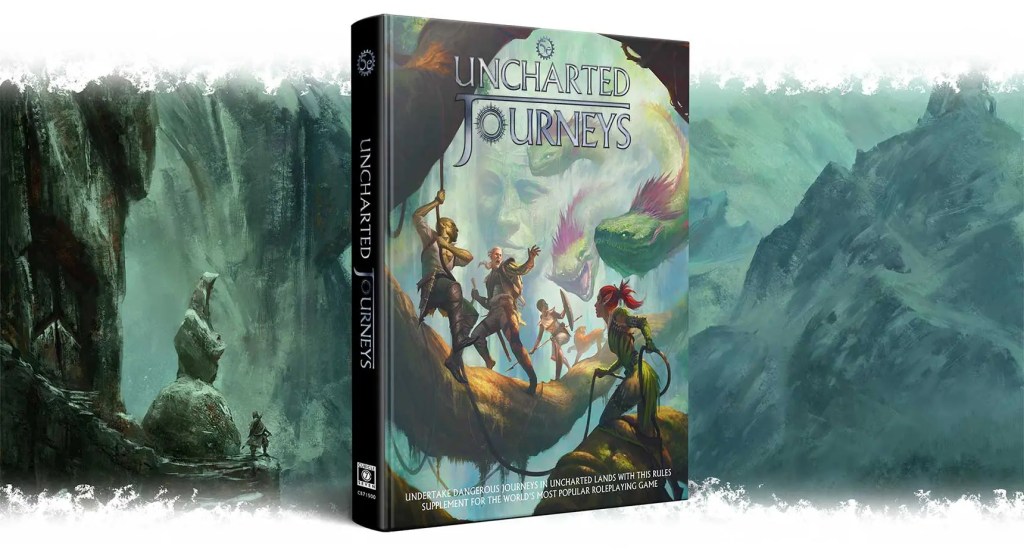
“Uncharted Journeys” For Traveling
In a lot of D&D games, traveling from one location to another that’s a significant distance away is pretty common. The Dungeon Master’s Guide does a good enough job of giving you some basic tools and flexibility on how you can run a travel scene in your game. They do acknowledge that there are a variety of ways you can do this and they’re all valid, so the tools are not meant to be robust but rather giving you something to take and run with.
Usually in my games, we will hand wave the travel part where we say that the party arrives after a certain amount of days, sometimes throwing in an encounter in there for narrative reasons or to give them an opportunity to get new magic items.
But earlier this year, my kid and I went to AdamCon and played The One Ring 2nd Edition from Free League Publishing. This was our first time playing the TTRPG based in the world of Middle-Earth of Lord of the Rings and we absolutely loved that game (you can read more about my thoughts on The One Ring). One of the things that we loved about it is the rules for Journeying, which included drawing a route on a map that determines how many encounters we would have, taking on a role during the Journey stage, and making checks that impacted what happened during our travels. It was a lot of fun seeing how this added another element of gameplay to the experience based on the decisions our characters made.
So I looked into how I could do something similar for my D&D games. Technically they have something similar for the 5th Edition adaptation of The One Ring, called Lord of the Rings 5E (also from Free League) but it definitely felt harsher in a lot of ways (there was a way where if you didn’t do well with your checks, you could just drop to 0 hit points!) But the publishing company behind the first edition of The One Ring, Cubicle 7, has a book called Uncharted Journeys that is exactly what I was looking for. It is very similar to how Journeying works in The One Ring: Your party set a route for the course of travel, they make some preparations for the Journey, then they make the Journey. Everyone in the party will take a Role during their travels, they can take certain actions that can impact the number and kinds of encounters they will have during their Journey, and they have special abilities they can use as well. They also have unique rules regarding Resting. Once per Journey the party can take a Short Rest, but Long Rests are not possible unless they have a specific encounter that allows for it. This makes the Journey experience feel more like a strategic challenge when your resources are more precious in this way. So I definitely encourage you to check this out.
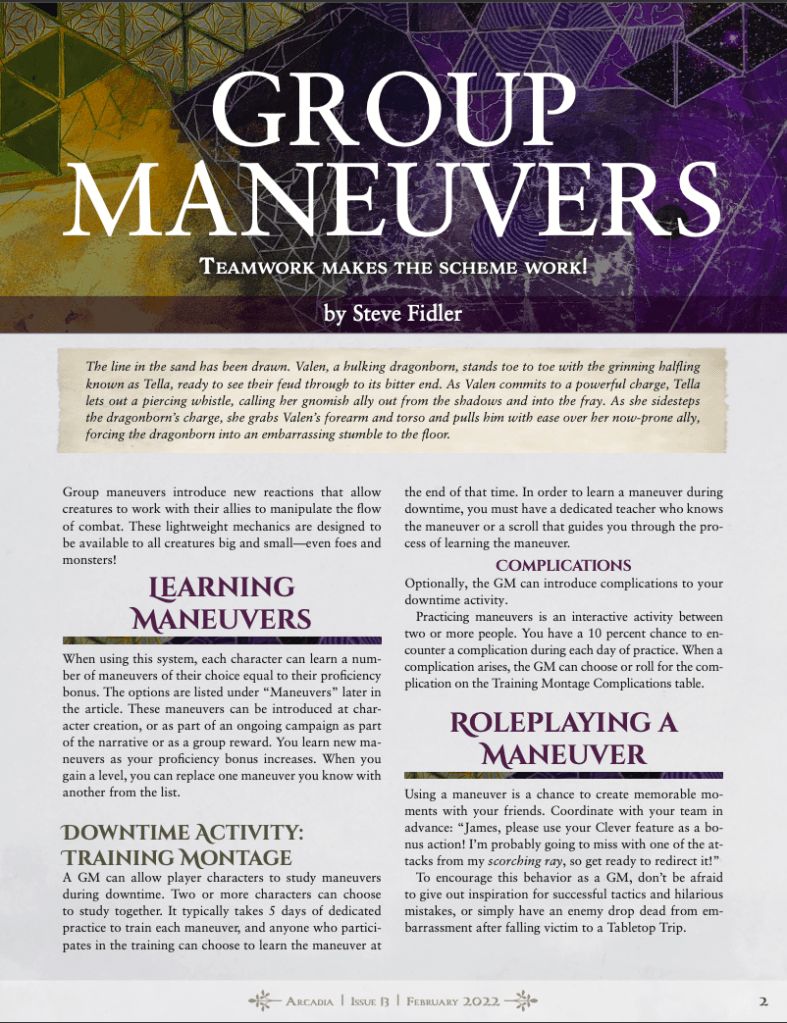
Group Maneuvers from MCDM’s Arcadia
Last year, Darrington Press released the explosively popular game Daggerheart, a new fantasy TTRPG that mixes dice and meta currencies with narrative driven mechanics. One of the things that my kid and I loved about this game is a mechanic that they have called Tag Team, where two players can team up to attack an adversary that can lead to some epic moments. It really encourages collaboration in this way and has that cinematic feel to it that you see in the movies (I always use the example of when Iron Man used Captain America’s shield to bounce his repulser blast to hit the bad guys in the Avengers film).
I was chatting in a Discord community I was in where I’d love to be able to do something like this and someone shared that Matt Colville’s production company, MCDM, actually released something like this in one of their Arcadia issues, called “Group Maneuvers” (in Arcadia #13, written by Steve Fidler). This new mechanic that they created allowed players to work together to do some epic things in combat, very much like Tag Team for Daggerheart. Players would learn how to do a Group Maneuver (up to their Proficiency Bonus), and can then use a Reaction to do the Group Maneuver to help with an attack that another party member is making. For example, you can launch a party member in the air, helping them move further, or a spellcaster can charge a weapon projectile like an arrow with a cantrip, which allows it to deal the cantrip damage on top of the weapon’s damage, too. This mechanic even encourages the players to roleplay this out in character, telling each other “hey, I’m about to do this so get ready!” Plus there’s not a lot of Reactions that players get outside of Opportunity Attacks, so this gives them more options if they want. And don’t worry – as a Dungeon Master, your monsters can also have Group Maneuvers as well! So if you love the Tag Team feature in Daggerheart, you’ll want to check this out.
Dungeoneering from Mystic Arts
I’ll admit that for the longest time, exploration was probably an area where I was the least sure about. I tried to emulate what I experienced in the games where I was a player and we would move through dungeons or areas that we haven’t been to before. But that wouldn’t always work. For example, I played in a game where our players would take turns taking a movement and doing a check of some sort as we would explore the area around us. So I did that in my own games but there were areas where it was pretty sizable and you could only have players do movement and checks so many times before you start running out of ideas on what they discover based on their checks.
And really this is just one example of a few ways where as a Dungeon Master, exploration was difficult for me to run. Now, I have pretty good idea on how to run exploration, but I’ll be honest and say that I wished I had known about The Dungeoneering Rules from Mystic Arts when I first started. This is a ten page document that provides a system for the DM and players based on the idea of “Dungeon Turns” that used to be a mechanic in previous D&D editions. The idea here is that players can explore a room or area on the map. This exploration turn takes 10 minutes. During these 10 minutes, the characters can perform a single action, like casting a spell that has a Casting Time of 10 minutes, Searching the room for hidden items or traps, or keeping a look out for other creatures that may be near by. These actions takes 10 minutes in game time, they roll checks associated with those actions, and you resolve them. Now, they can do another action in that room if they want but it’ll take another 10 minutes to do. But the players also know that the more time they spend on the map, the more the environment reacts to them because the system provides the Dungeon Master a set of tools that determines what triggers an additional wandering monster or event in their area based on how much time they’ve spent.
This system really improves the exploration experience for me and my tables because it resolves what players want to do, what they discover, and your table can focus on the story rather obsessing over investigating every five foot square in the room. As a Dungeon Master, this allowed my prep to be easier as well because I no longer have to come up with 30 discoveries because they’re doing an action for every round, but their action takes 10 minutes and they only need to do one roll for that. Which, makes sense because if they spend 10 minutes in the room looking for traps and they succeed, you can tell them what they find in terms of traps in the room, rather than the inevitable “searching for traps every five feet and needing to roll for each square of movement.:
Now by the time I had discovered this, I had already had my own system in place. So when I read it, it basically confirmed that I was doing 90% of this already, but it was really good to see that something I put together in my own games is also a best practice that other DMs used for their games as well, so it was still worth the purchase for me.
What Other Tools Should Be On This List?
I’m very excited to be using or plan to use these tools in my campaigns but I know there are still a lot of DM tools out there that can provide a great experience for DMs. So let me know what tools you would add to this list.
As always – go Reckless or go home.
 Crit Hit The Giant
Leave a comment