When I first started my journey into Dungeons & Dragons a few years ago, I learned to play like many people did at that time: joining a table as a player, made a character, then just tried to pick up the rules of the game as we went along.
And also… by playing Baldur’s Gate 3.
But shortly after, I decided to become a Dungeon Master because my kid and my friends wanted to learn how to play and I was the only person they knew who could teach them. So I started to read the 2014 Dungeon Master Guide in preparation for those tables. But I felt like it was really dense and I was still trying to figure out the basic rules to the game, so I decided that I’d just learn how to run games as we went along.
Then the 2024 core rule books came along and this was the first time I’ve read the Player’s Handbook, Dungeon Master Guide, and Monster Manual in its entirety. And in my opinion, the readability of those books were much better than their 2014 counterparts.
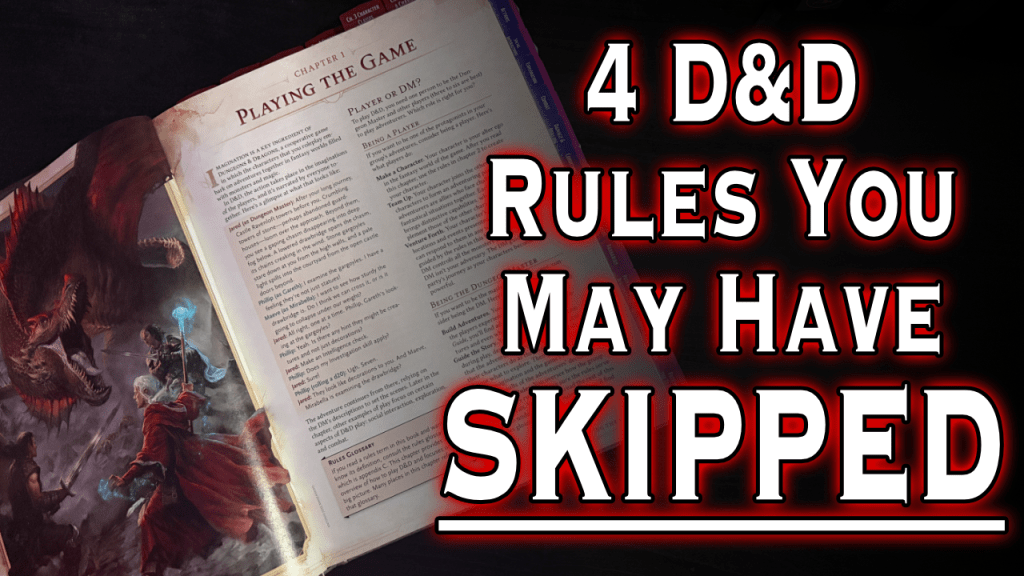
But even then, there’s a lot that you can miss and there are still rules that I’m realizing I have not been using that I thought are actually really helpful to know and use as a Dungeon Master tool. So here are 4 rules from the 2024 rules that I “rediscovered” that I have since been using more in my games.
The Help Action And Ability Checks
Many of us know that if you provide an ally the Help Action when they’re attempting to succeed on an ability check, then you can give them Advantage. But what you may not realize is that you need to have proficiency in that skill in order to provide the Help Action.
Assist an Ability Check. Choose one of your skill or tool proficiencies and one ally who is near enough for you to assist verbally or physically when they make an ability check. That ally has Advantage on the next ability check they make with the chosen skill or tool. This benefit expires if the ally doesn’t use it before the start of your next turn. The DM has final say on whether your assistance is possible.
Player’s Handbook, pg. 368
I actually think this makes a lot of sense. And help here isn’t the same as when I was a kid my dad asking me to hold the flashlight so he can see under the car while he worked on it. I’m just really replacing a lamppost.
Helping here is meant to be a way where you can assist someone because you know what you’re doing in that particular skill. I think this has a really cool roleplay opportunity, especially if you’re providing the Help action to someone who doesn’t have proficiency in that skill.
Targets Get Half-Cover If Someone Is In The Way
In a lot of my games, my players always ask me if they tried to make a range attack against an enemy if they may risk hitting someone in their party if their ally is in between them and the villain. And I love that. They’re wanting to make sure that they don’t accidentally injure someone when they’re trying to attack someone else. And the answer, rules as written, is no.
But what that does mean is, if another creature is between you and your target, that target gets a bonus to their Armor Class and Dexterity Saving Throws.
In the Player’s Handbook, it states that a creature is considered to have Half Cover if there is another creature or an object that covers at least half of the target. And Half Cover provides a +2 bonus to the target’s Armor Class and Dexterity Saving Throw (pg. 26). Now, “half of the target” can be a bit ambiguous. You might rule that the target is Medium size and the creature that’s between the attacker and the target is Small, then they may not have Half-Cover. So obviously creature size does come into play when thinking about cover (I like to think that my Barbarian Path of the Giant can give their party some protection this way when they Rage into Large or Huge size).
So if you want to make that range attack, go ahead! You won’t risk hitting any ally but it will be slightly tougher to hit your target because of the.
The Study Action And Monsters
The 2024 rules have categorized different skills into types of Actions. For example, the Study Action is anytime you are making an Intelligence check for Arcana, History, Investigation, Nature, and Religion skills. Essentially, you’re trying to recall some kind of information related to those areas.
You may have had moments in your campaigns where a character wants to try to see if they know more about a monster. They can take the Study Action to do this.
But which skill should the Dungeon Master call for? It depends on the creature type of the monster in question. In the Rules Glossary of the Player’s Handbook, it actually provides guidance on how to do this:
Arcana: Aberrations, Constructs, Elementals, Fey, and Monstrosities
History: Giants and Humanoids
Nature: Beasts, Dragons, Oozes, and Plants
Religion: Celestials, Fiends, and Undeads
pg. 375
Now, the Dungeon Master Guide does not provide guidance on what kind of information the character can learn based on these checks – that’s really up to you because there’s a lot of context and nuance in those situations. If it’s in the middle of combat though, it does take an Action to do this unless the character has an ability or feature, such as Keen Mind which allows you to take the Study Action as a Bonus Action (so that definitely comes in clutch in combat).
As a player, you may have played enough games where you know what a creature can do already, but it’s always a good thing to ask your Dungeon Master what your character may know so you can play with your character knowledge rather than your player knowledge (obviously if your Dungeon Master allows for that, then this doesn’t apply).
Influence Action Against Hostile Creatures
As a Barbarian, I LOVE trying to use my Intimidation Skill to convince non-playable characters (NPCs) to either give up a clue, let us pass through, or something that doesn’t have to resolve in violence. But the creature’s attitude towards you can impact the chances of you succeeding on that ability check.
Skills like Deception, Intimidation, Persuasion, and Animal Handling are all considered part of the Influence Action. However, if the creature you’re trying to Influence is Hostile towards you, then you have Disadvantage to that ability check. The DC is also set against either 15 or the creature’s Intelligence score, whichever is higher (Player’s Handbook, pp. 368-367). So trying to Intimidate the enemy to stop attacking you while you’re in combat may prove to be difficult for that reason.
But there are a few things that can help with this situation, such as someone casting Thaumaturgy to try to Intimidate someone with Booming Voice. When this happens, you have Advantage on that check, which will cancel out the Disadvantage on the check.
If you’re a Dungeon Master and you want to handle this a different way, what you could do is allow your players to still roll an Influence skill check but instead of imposing Disadvantage, you just add a +5 on top of what the DC would have been, which is the bonus that is used when someone has Advantage or Disadvantage. So it makes it more difficult still but now your player to try to do that cool thing. Personally, there’s something more encouraging about being able to do something without Disadvantage.
Conclusion
In the game of Dungeons & Dragons, there are more rules like this where it can be obscure or is not used as often that can be easy to forget. Let me know some of your favorite rules that you like to use your game that you think is unique and interesting.
 Crit Hit The Giant