Over the weekend, I took my kid to see Lord Of the Rings: The Fellowship of the Ring in theaters for its 25th Anniversary. I watched it in theaters when it first came out when I was in high school, so it was nice to have that experience with my kid to watch it for the first time in theaters, too. (I was worried with it being the extended version that he would get tired or bored, but he loved all of it!)
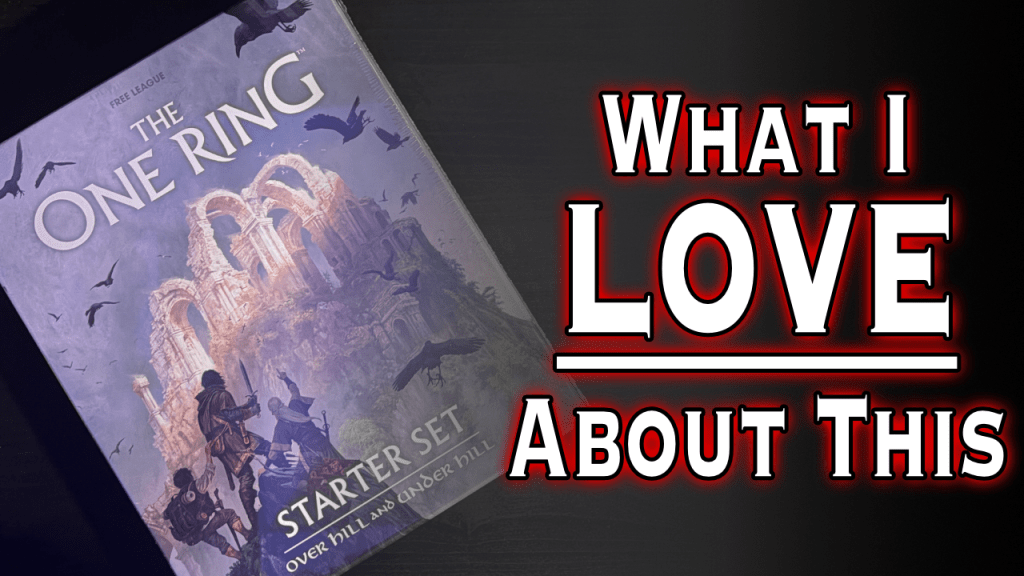
The next day, we headed out to AdamCon, a free gaming convention in Cincinnati. We saw that someone was running The One Ring Starter Set from Free League Publishing as an event for the convention. As someone who has wanted to play this system for a while now and my kid’s excitement to play a game in the Lord of the Rings setting, we signed up to play.
And it was such an amazing experience.
There was so much we enjoyed about playing the game that we couldn’t get over how much fun it was. Our go-to tabletop roleplaying game (TTRPG) is always Dungeons & Dragons, but we love trying out new systems and this has risen immediately to the top of our favorites to play. I’ve always been a huge fan of Free League Publishing (my first TTRPG campaign I’ve ever played was Dragonbane), so I knew it was going to be a good game going in.
But I can’t tell you how much I’ve thought about this game since then. To the point that I’ve started taking the pieces that I liked about this game and started to port it over to my Dungeons & Dragons game that I run for a kids table (and they loved what we added!).
So here’s a Quick Look at what I loved about playing this game.
DISCLAIMER: I have not read the rules other than quick glimpses. This post is entirely based on my one time experience with this game in the one shot that I played.
The Mechanics
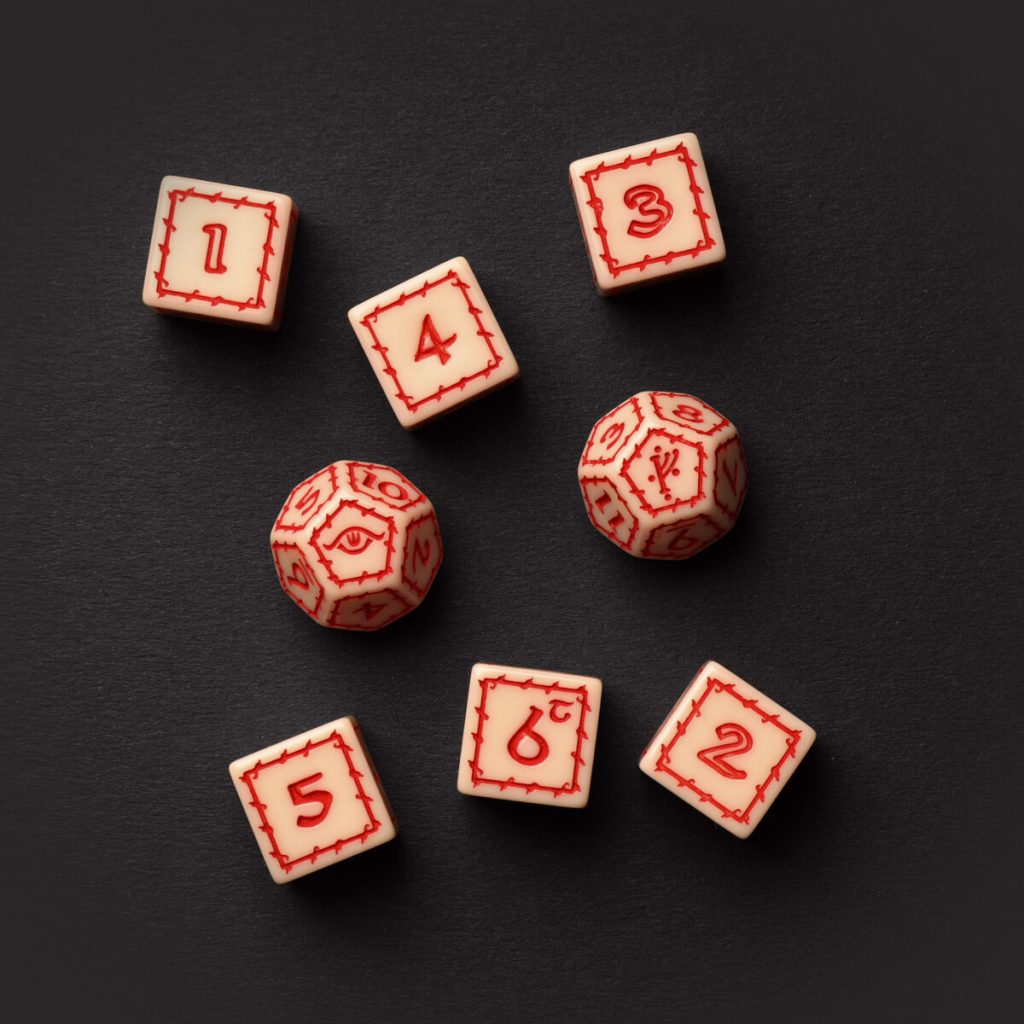
The One Ring, designed by Francesco Nepitello and Marco Maggi, uses a unique dice mechanic. Whenever dice rolls are involved, they involve a Feat die and a Success die. A Feat die uses a d12. In practice, it’s actually a d10 with two additional unique results, so the highest value you can ever roll is a 10. The other two unique results has the Eye of Sauron (or an 11 on a regular d12), which results in a 0; the other is the Rune of Gandalf (12 on a d12) which is an automatic success.
The Success Dice is a d6 that a player would usually roll along with their Feat die. The 6 on the die would have the Tengwar rune on it as well. Depending on the circumstances, you may be rolling anywhere from 0-10 Success Dice on a roll.
In most cases, when you make a dice roll such as a skill check or a combat roll, you are going to roll your Feat die plus how many Success Dice that you are able to roll, depending on the type of check and circumstances. When you roll, you add the values together to get your result and compare it to your Target Number, which is based off of the Ability you rolled for on your character sheet. If you meet or beat that number, then you succeed. However, here are a few things that can change or add to the result:
- If your Feat die result is the Eye of Sauron, your roll fails automatically, no matter what the result is of the Success dice.
- If your Feat die results in a Rune of Gandalf, your roll succeeds automatically, no matter what the result is of the Success dice.
- Your roll may have Favor, meaning you roll 2 Feat dice and take the better result, or Ill-Favor, meaning you roll 2 Feat dice and take the worse result (similar to advantage and disadvantage in Dungeons & Dragons).
- If you roll a 6 (Tengwar Rune) on a Success Die and your roll succeeds, then you get something extra for your result, depending on what kind of roll you make (e.g.
I don’t know what it is about the fact that you’re rolling a d12 and a handful of d6s, but compound that with different ways you can succeed and produce different kinds of results – there’s something exciting about this mechanic!
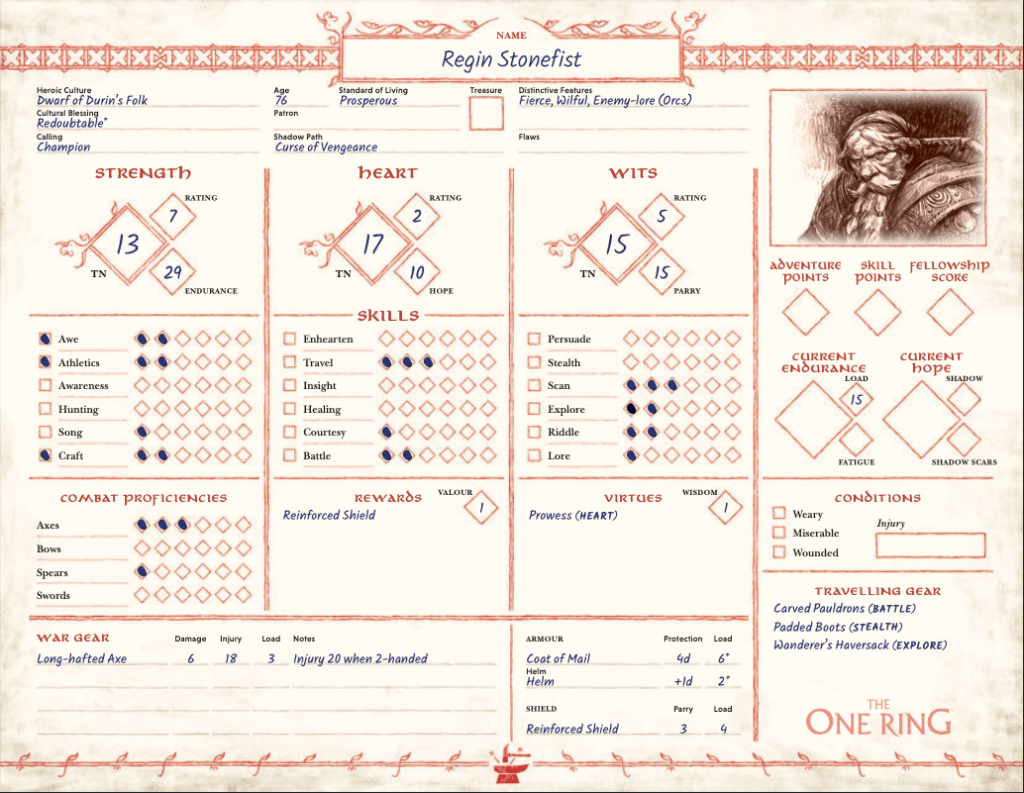
The character sheet in The One Ring also provides you the information you need in a succinct way. You have 3 main abilities that all skills and rolls are derived from: Strength, Heart, and Wits. In these 3 abilities, your Target Number (TN) for succeeding in your Skill Check is what you always strive to meet or beat. Your character sheet also provides information on how many Success dice you roll for that skill, as well as if you’re Favored for it. The character sheet is very clean, easy to read, and the artwork for it really fits the theme and aesthetic for a Lord of the Rings game.
Journeying
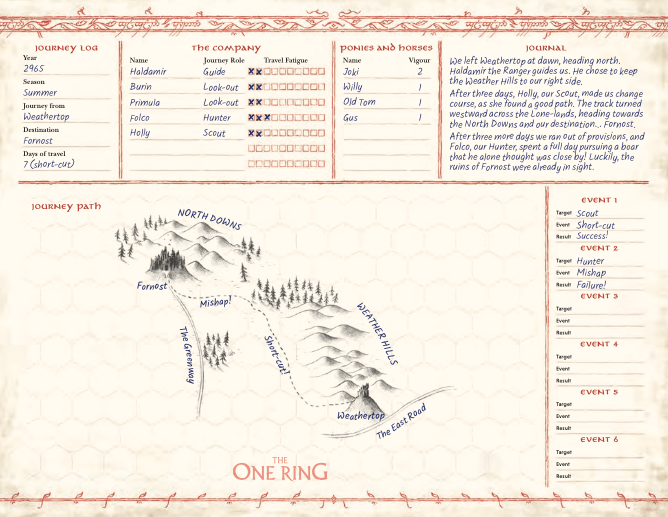
A core piece of both the story of Lord of the Rings and the game is the journeys they take. The game does a fantastic job of making the Journeying sequences meaningful, exciting, and fun. When the Company (the name for the party) decides to journey from their current location to another that requires multiple days of travel, everyone takes on a role that serves different functions: Guide (the person in charge of decisions for travel), Hunter (in charge of finding food), Look-Out (the person in charge of keeping watch), and Scout (the person in charge of setting up camp and finding new trails).
Before the Journey begins, the Guide will talk to the Company to decide how they will get to their destination by taking the map that the Loremaster (the title for the Game Master in The One Ring) will provide. The Guide will draw their path, which will determine how many days they travel (the players will not know, but the Loremaster will compare it to a hex grid version of the map; each hex equals 1 day of travel). The Guide will then make a Travel check. If they succeed, then the Company will travel for 4 days before an Event occurs. If they fail, then an Event will happen in 2 days (or sooner, depending on circumstances).
When an Event occurs, the Loremaster rolls a d6 to determine who in the Company the Event will affect (the Guide is not part of this selection process). Then, the Loremaster will roll a Feat Die to determine what kind of Event the Player Hero (the official name for Player Character in the game) will face. The Player Hero(es) with that role will then do a Skill Check to see if they are able to endure the event. If they fail, then a consequence will occur, giving the Player Hero a negative mechanical effect as well as accruing Fatigue Points, which also affects the overall health of your character. The company then repeats this entire process until they arrive to their destination.
The stage where the Event occurs is great because this is mostly a narrative component where the Loremaster can describe what the character is facing, then after the Player Hero rolls, they (or the Player Hero) can describe how they are able to either overcome or succumb to the Event. I am a fan of having a way to incorporate narrative with mechanics like this so that it gives meaning but player agency and fulfillment at the same time.
I also love how the Company gets to decide the course of their journey by actually drawing on a physical map. It’s a simple yet effective way to bring that sense of realism to the game that doesn’t require more than a printed map to achieve this. My kid and I absolutely loved this experience. So much so, I ended up incorporating this idea of Journeying into the Dungeons & Dragons campaign that I run for them and the other kids at our table.
Combat
Combat is already unique in The One Ring because of the dice mechanics, but there are also other elements about combat that makes The One Ring a lot of fun. First, combat is side-based Initiative, meaning that each side takes a turn in combat, with the Company going first (unless the Loremaster things that the enemies somehow have the advantage).
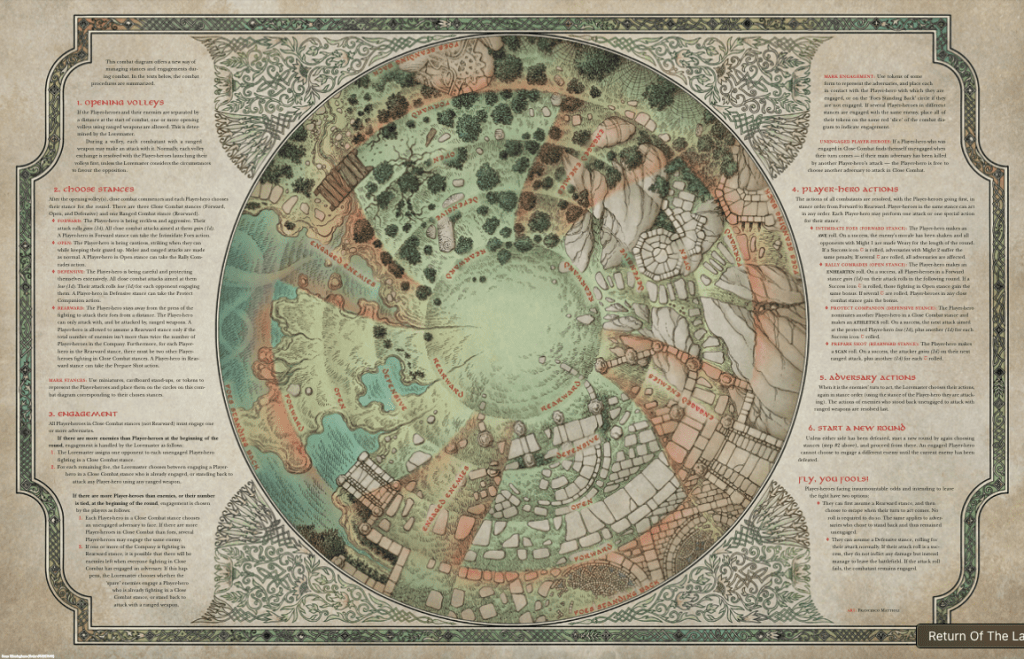
Combat starts with an Opening Volley, meaning each side takes a turn doing a range attack against the other (each character only attacks one character on the other side each turn). After Opening Volleys, then Close Quarters Rounds occurs. This is where each character decides what kind of stance they will take and who they engaging with (i.e. who they are specifically attacking). A stance gives you a specific method in which how you will attack, which has mechanical effects:
- Forward: You attack recklessly, adding a 1d6 to your attack roll; all close encounters attacks against you also has a 1d6 added to their attack rolls.
- Open: Essentially, you roll a straight attack roll; enemies targeting you also roll straight attack rolls.
- Defensive: Each attack against you lose a 1d6 to their attack roll; however, you lose a 1d6 for each enemy targeting you to your attack rolls.
- Rearward Stance: This is engaging in a Ranged Attack. You can only make ranged attack rolls at enemies who are also in a Rearward Stance, which also applies to the enemies.
For each round of combat, you decide who you are engaging with and what Stance you take. Everyone takes their turns, then the process is repeated. Combat in The One Ring does not have Speed, and the damage dealt to the characters are static damage, meaning that you never roll for damage but rather you deal the same amount of damage every time you hit.
The Starter Set comes with a map that has instructions on combat as well as a nice design to show what stance each character on each side is on. This made combat easy to get into as well as giving a nice visual on what’s going on on the battlefield.
What I also love about Combat in this game is that if you roll a Rune of Gandalf on the Feat Die or a 6 on any of your Success Dice, then you can inflict special damage (assuming that your attack is successful). For each 6 that you roll, you can inflict multiple Special Damage or the same type of Special Damage multiple times. Special Damage includes Heavy Blow (inflicting additional loss of Endurance), Fend Off (add a Bonus to your Parry roll), Pierce (adding a + 1, +2, or +3 to the result of your Feat Die, depending on your weapon, which can trigger a Piercing Blow), and Shield Thrust (the enemy suffers a penalty of 1d6 to their attack roll). If you roll a 10 or a Rune of Gandalf on your Feat Die, then you can attempt a Piercing Blow, which may immediately kill the enemy. When this occurs, the person who was attacked must do a Protection Roll, which is determine by rolling a Feat Die plus the amount of Success Dice equal to their value of their Armor worn. The roll is contested against the Injury number of the weapon that was used to deliver the Piercing Blow on that character. If the NPC was the one to make a Protection Roll fails, then that NPC dies outright; if the Player-Hero is the one that fails a Protection Roll, then they sustain a Wound, which has severe effects on the character.
At our one shot, we had two combat scenes and I can’t tell you how much fun we had looking at our rolls, seeing what outcomes we had, and resolving them. Being able to add a special effect based on the random roll results of your dice in a number of ways is just so much fun.
Council
The final aspect of this game that I wanted to share my love for is this concept called a Council. Similar to what we see in many social encounters in Lord of the Rings, a Council is a type of social roleplay that the Company might participate in when it’s a formal gathering with a group of people and the stakes of the outcome of this encounter is high. This method is, as suggested, a formal way of interacting with people that acts as a procedural series of interaction checks from the Player Heroes in the Company to help them influence the other party in making a decision.
A Council will start with a Player Hero making an Introduction (they formally introduce themselves and other people in the Company). After the introduction and a statement of their purpose, the Player Hero makes a Skill Check to determine how many rolls the Company can make to try to successfully influence the other party. A failure means the number of attempts the Company can make is 3; a successful roll sets the number of attempts at 4 plus any additional 6’s that were rolled as part of that skill check (e.g. if the Player Hero succeeds at the roll and their 3d6 was a 2, 3, and 6, then the attempt number is set to 5). The Loremaster will also set a Resistance target number based on the objective and circumstances of the Council (3, 6, or 9) to determine how many successes the Company must make in order to succeed with the Council.
As the social roleplay occurs, the other members of the Company can share how they are attempting to help persuade the encountering party. Maybe they are trying to impress them, sing them a song, say a riddle, etc. Then the Player Hero will roll the appropriate check. A successful check counts as a success and any 6s that are rolled on the Success Dice also counts as a success (so you could roll once and get 3 successes if your roll succeeds and you roll 2 6’s).
This is a very clever, strategic way of doing a roleplay that is formalized into a goal-oriented event that’s driven by an objective and the stakes, instead of relying on individual rolls for different circumstances. Again, this felt like playing out an event in the Lord of the Rings and made this type of encounter fun as well as engaging. Sometimes, having a procedure and an identified purpose can really bring out the best gameplay possible.
Final Thoughts
I haven’t stopped thinking about this game since I played it. I’ve skimmed through the rules for The One Ring as well as the 5th Edition Lord Of The Rings, and I just really love how much thoughtfulness went into the design of this game. It’s so unique compared to anything else I’ve played, and I really hope to play more of The One Ring in the future (hopefully at GenCon!).
![DUNGEONS & DRAGONS REVEALS NEW ERA FOR FANS WITH WORLD OF WARCRAFT®, DARK SUN, AND STAR WARSTM EXPERIENCES [Press Release]](https://crithitthegiant.com/wp-content/uploads/2026/07/image-1.png?w=1024)
 Crit Hit The Giant
2 responses to “What I Loved About Playing The One Ring”
Minor rules note – the Eye symbol is just a 0, not an automatic failure. It is only an automatic failure when you have high Shadow and are therefore “Miserable”.
Glad you enjoyed it!
LikeLike
Thank you for the clarification! I appreciate that. I’ll make that update now
LikeLike