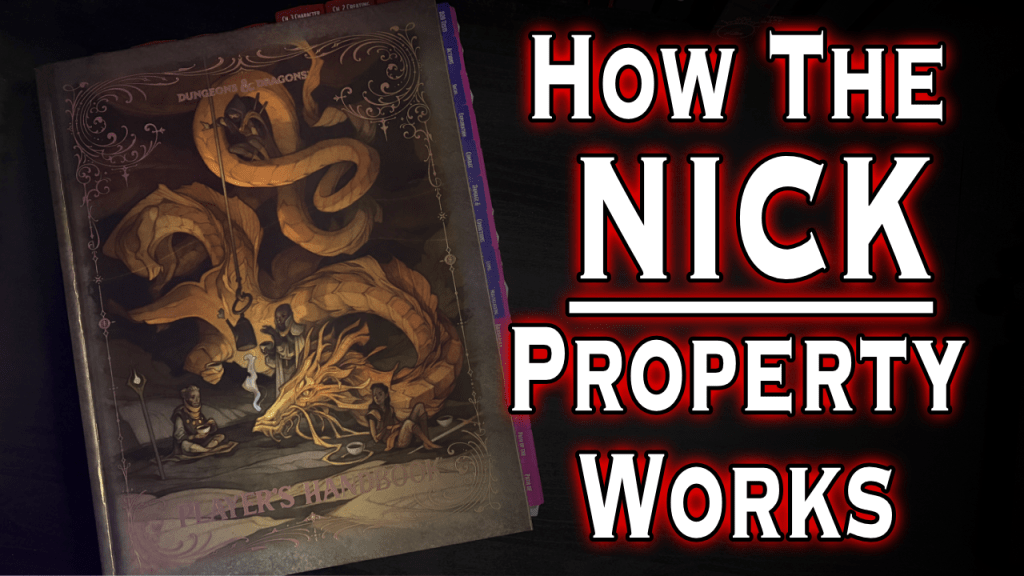
When the Dungeons & Dragon’s 5th Edition 2024 released, one of the biggest and exciting additions they made to the rules is Weapon Mastery Properties. Similar to what you may have experienced in the video game Baldur’s Gate 3, Weapon Mastery Properties allows you to do something extra with your weapon attack. For example, if you have a Greataxe, you can use the Cleave property, which allows you to take an additional attack against an enemy that’s within your reach and 5 feet of the enemy you just hit with your weapon.
But one of the most confusing Weapon Mastery Properties that trips people up is the Nick Property. Then it can get even more confusing if someone takes the Dual Wielder Feat later on as well as getting more attacks with the Attack Action. But if we frame this line of thinking a certain way, I think it’s actually easy to understand and figure out every time the Nick property is used if we think of this properties and features as a series of checklists on your turn. So let’s break it down. At the end of this post, I’ll also have a Quick Reference section that you can use to refer to or even copy into your notes if you want.
First of all, a shout out to CRG at the Lawful Neutral DM blog – they were the one that gave me the inspiration for making this post when we were discussing this topic in Sly Flourish’s Discord server recently.
How The Light Property And Nick Property Interacts
First of all, in order to use a weapon mastery property, you have to have a Feature that gives you this benefit, which you can get from classes like Barbarian, Fighter, Paladin, Ranger, and Rogue, or take the General Feat Weapon Master. Additionally, you must have selected which weapons you have mastery for in order to use that benefit as well.
Understanding that requirement, let’s look at the definitions of the Light Property and the Nick Mastery Property.
Light Property. When you take the Attack action on your turn and attack with a Light weapon, you can make one extra attack as a Bonus Action later on the same turn. That extra attack must be made with a different Light weapon, and you don’t add your ability modifier to the extra attack’s damage unless that modifier is negative.
This definition is pretty straight forward and is very similar to what we have in the Two-Weapon Fighting ability in the 2014 rules – they just made it where you don’t need a special ability or feat to use it now.
Nick Property. When you make the extra attack of the Light property, you can make it as part of the Attack action instead of as a Bonus Action. You can make this extra attack only once per turn.
Now, as you read this definition here, you might have picked up that there is something not entirely clear about this definition, which has been a topic of discussion ever since the book was released. It doesn’t clearly say which weapon is being used for the extra attack. In other words, let’s say I’m wielding a Shortsword and a Dagger, where both weapons are Light weapons and Dagger has the Nick Property. Do I need to attack with my Dagger first in order to activate the Nick Property to use my Shortsword as part of the Attack Action, or do I need to attack with my Shortsword first in order to activate the Nick Property on the Dagger?
I personally think that this definition has been left vague purposely to give the player decision power on the order in which it is being used. In the end, it’s not going to matter what is the order of operations with the Nick property (although one could definitely argue that it might). But for the purpose of this post, we’re going to assume that the Nick Property is activated when a different Light weapon is used for the Attack (in the example above, the Shortsword attack is activating the Nick Property for the Dagger).
So to see this in action, let’s assume that our level 1 character is wielding a Scimitar and a Dagger, which both have the Light and Nick properties, and let’s assume that our character has chosen both of these weapons to have Weapon Mastery Properties in. And as I mentioned before, we’re going to treat the Light Property and Nick Property as a checklist, meaning once I use that property, I can’t use it again on my turn.
When I attack with a Scimitar, that will activate the Light Property, which will allow me to attack with my Dagger has a Bonus Action since both the Scimitar and Dagger have the Light Properties. So this means that I have checked off using the Light Property on my turn.
Because the Dagger has the Nick Property, however, I can make that attack with the Dagger as part of the Attack Action I used on my scimitar, instead of using a Bonus Action to make that attack (I still do not add my modifier to the damage for this second attack with the Light Property). This means that now my Bonus Action is freed up to use for a different ability I may have (e.g. Hunter’s Mark for Rangers or Cunning Action for a Rogue). Now that I have used the Nick Property, I can check that off of my list to show that I’ve used that feature on my turn.
Can I Use The Nick Property Twice In A Turn?
Short answer – no.
Per the Nick Property definition, you can only use the extra attack once per turn (referring to the extra attack that is being used from the Light Property). Because you have used it on your turn, you have checked it off of your list on your turn, even if the other weapon also has the Nick Property.
So the lesson here is, it is optimal to use weapons that both have the Light Property but only one of them has the Nick property. That’s why the best combination is to use Shortsword and Scimitar, since they’re both Light weapons, Shortsword gives you Vex (if your weapon hits, your next attack roll against that creature has Advantage), and Scimitar allows you to attack as the Attack Action with the Nick property, dealing 1d6 damage (instead of Dagger’s 1d4).
What If I Have The Dual Wielder Feat?
That’s an excellent choice to make if you want to utilize two weapon fighting in a number of ways. Taking the Dual Wielder Feat will give you the following ability:
Enhanced Dual Wielding. When you take the Attack action on your turn and attack with a weapon that has the Light property, you can make one extra attack as a Bonus Action later on the same turn with a different weapon, which must be a Melee weapon that lacks the Two-Handed property. You don’t add your ability modifier to the extra attack’s damage unless that modifier is negative.
So, how does this impact using weapons that have the Light and Nick Properties? It essentially allows you to use your Bonus Action to make a 3rd attack with your Scimitar. Here’s how.
We’re already established that if I use the Attack Action to attack with a Scimitar that has the Light Property, that triggers me to use the Dagger for my second attack, which I can use as part of the Attack Action because of the Nick Property, freeing up my Bonus Action. Keep in mind that the Scimitar has triggered all of this so far, and at this point we’ve checked off using the Light Property and the Nick Property to attack.
But the Dagger hasn’t triggered anything yet. In this case, I can use the Dagger to trigger the Enhanced Dual Wielding to attack with my Scimitar as a Bonus Action, since it is a different weapon from the Dagger. So now we can make our 3rd attack with a Bonus Action, checking off that we have used Enhanced Dual Wielding.
So How Does Extra Attack Factor Into This?
Most martial characters will get an extra attack at level 5 of their class, letting them take an additional attack when they take the Attack action. When your character reaches this point, it can make a 4th Attack using this extra attack option.
Does this 4th Attack benefit from using the Nick Property again? No, because as the Property states, you can make this extra attack only once per turn, which you did when you took your second attack.
Does this 4th Attack benefit from using the Enhanced Dual Wielding feature? No because you’ve already used your Bonus Action.
Quick Reference Guide
As shown, the best way to think of how this works is to look at the features that are being used and treat them as a checkbox of things they can do on their turn. Your checklist includes:
- Attack With Light Property
- Attack With Nick Property
- Enhanced Dual Wielding
- Extra Attack
Here is a Quick Reference Guide for you to use if you need a reminder on how a martial class with a Nick weapon mastery can do 4 attacks at level 5.
- Character must have Weapon Mastery Property for a weapon that has the Nick Property
| ACTION | WEAPON | PROPERTY/FEATURE USED |
| Attack Action (First Attack) | A Light Weapon | Light Property |
| Attack Action (First Attack) | A Light Weapon With The Nick Property | Nick Property (moves attack from Bonus Action to triggering Attack Action) |
| Bonus Action | A Light Weapon | Enhanced Dual Wielding from “Dual Wielder” Feat |
| Attack Action (Second Attack) | Any Weapon | Level 5 Feature |
 Crit Hit The Giant