
Since its release on May 20th of this year, Daggerheart from Darrington Press has been the hottest tabletop roleplaying game. And for good reason! It’s a well designed game, very easy to get into, a good balance between roleplay and combat, and a whole slew of best principles and practices that makes the game and the table fun.
The game was developed under the umbrella of Critical Role, the popular Actual Play and multimedia entertainment company that consists of voice actors that love playing Dungeons & Dragons. Coincidentally (and like for many others), they are the group that got me hooked into playing tabletop roleplaying games, so naturally I wanted to check out Daggerheart.
I can’t overstate how much I love this game (as a player; I’m still on the fence as a game master since it’s not exactly my style for running games). And it has inspired me to think about how I run my games, particularly in Dungeons & Dragons.
Don’t get me wrong – D&D is still my favorite TTRPG to play and I don’t know if any game will ever replace that. But Daggerheart will be close to it. And I’m always a fan of taking things that you find fun in other games and use them in your current ones (after all, a good portion of Daggerheart are mechanics and ideas that exists in other TTRPGs already).
So here are three things I’m going to borrow from Daggerheart and introduce into my D&D games.
WATCH THE VIDEO VERSION
Rather watch the video instead? Check it out below.
DEATH MOVES
Death Moves in Daggerheart is a mechanic that players have when they mark their last Hit Point (equivalent to dropping to 0 Hit Points in Dungeons & Dragons). When this happens, the player has three choices to make in regards to the fate of their character: Blaze of Glory, Avoid Death, and Risk It All.
With Blaze of Glory, your character will embrace death but not before making one epic final action. The player can choose what is their last action that they will make, and that action will be a Critical Success automatically. After they make this action, their character dies.
Turns out that there have been existing homebrew rules in Dungeons & Dragons that has a similar mechanic/idea with Blaze of Glory. This ports easily to D&D by allowing the character to do one last final action on their next turn. They can have any spell slot level their character has access to, even if they have spent all of their spell slots at this point (but again, they can’t have access to higher level spells or spell slots if their character didn’t have it previously). The piece I emphasize with this is that no matter what happens, their character will die. So they can’t cast Wish and try to cleverly get out of it. It would go against the spirit of this mechanic, and what I am trying to do is give players agency on how they want their character to end their journey with this option.
Avoid Death in Daggerheart is when a player elects to have their character to immediately go unconscious. When this happen, they will not be targeted, and they remain unconscious until someone clear one of their Hit Points (or heal, in D&D terms) or finish a Long Rest (although it’s unclear what happens to the character if they finish a Long Rest without clearing a Hit Point). In addition, they roll their Hope die. If the number they roll is equal to or lower than their character level, then they gain an permanent scar. This means they need to permanently mark out a Hope slot (which is a resource that players have access to active different types of abilities). Once they cross their 6th Hope slot, then their character must end their journey, which can be death, retiring, or another narrative solution.
For Dungeons & Dragons, this mechanic is also easy to transfer into for the most part. The only barrier is the permanent scar option because there isn’t a resource equivalent of Hope in Dungeons & Dragons. For now, I’m going to experiment with having the players roll a d20. If they roll at their character level or lower, then they need to take a permanent -2 to an ability score of their choosing. They can only do this to one ability each. After they mark their last ability this way, then their character must end their adventure journey as well.
Risk It All is also easy to transfer as well. In Daggerheart, the player rolls their Duality Dice, which are 2d12s. One d12 is their Hope die, and the other is their Fear die. If the Hope die is higher, then the player bounces back into action. They also get to clear a number of Hit Points and Stress (another resource economy in Daggerheart) equal to the number they rolled on their Hope die (the total number is what they have to split. E.g. if they rolled a 7, they can clear 4 Hit Points and 3 Stress). If their Fear die is higher, however, then their character dies. For Dungeons & Dragons, this is essentially Death Saving Throws. But in this instance, they just roll once on their next turn. If they roll an 11 or higher, then they’re back in the fight, gaining a number of Hit Points equal to what they rolled (to their maximum HP). If they roll a 10 or lower, then the character dies.
Now obviously there are a few edge cases that you’d need to work out with adopting any of these Death Moves. For example, what do you do with the character that has the cantrip Spare The Dying? In this case, I’m working on a homebrew rule that allows that spellcaster to use their Reaction to cast it (and they have 30 feet range). When they do cast it, then the person making the roll can roll their Death Saving Throw with Advantage. I’m sure there will be other odd situations that come up, but as long as you have a conversation with your table about how to handle it and to make decisions in good faith, this should be a good substitute for Death Saving Throws, assuming this is of interest to you.
TAG TEAM
This mechanic is undoubtedly one of the most popular mechanics in Daggerheart. Every time I run a learn to play one shot or currently running a game at my kids table, everyone loves this move.
Tag Team is exactly what it sounds like. A player can initiate a Tag Team action with another person at the table. This costs 3 Hope and you can only initiate it once per session (but you can participate in other Tag Team action rolls if someone else initiates it with you). When this happen, both of you describe how you’re working together to attack an adversary. When you do, both of you roll your Duality Dice and you pick between the two rolls to be the final result. If the result you choose succeed, then both players roll damage and combine that damage to be dealt to the adversary. Pretty awesome, right?
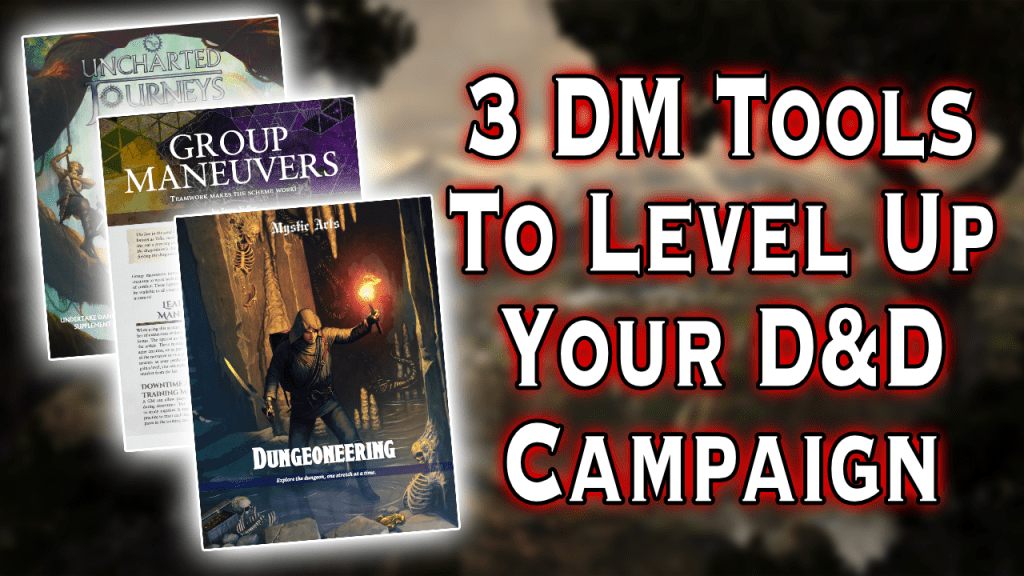
If you’re thinking, “This would be great to do this in Dungeons & Dragons!” then I have good news for you. Someone actually made something very similar a few years ago, called Group Maneuvers. First introduced in Matt Colville’s magazine, Arcadia, Group Maneuvers allows characters to learn certain moves that uses their reaction to add or help another party member during combat. And there’s a wide range of options that are really cool, and there are optional mechanics on how characters can train to learn these actions. It’s definitely worth checking out and purchasing the bundled set to have access to this, as well as some other great ideas that Arcadia provides.
BACKGROUND & CONNECTION QUESTIONS
Less of a mechanic and more of a process, Background & Connection questions are a core process to creating your character in Daggerheart. Although not unique to this game, Background questions in Daggerheart provides 3 questions for the player to answer about their character. Each question is tailored to the class that you’re playing, and they’re just enough to get you started without feeling like you need to write a chapter of information.
Connection questions is usually done at a Session 0 with your table, where characters go around and ask other characters how they know each other prior to the campaign. This is a great way to be able to connect your party so you don’t have to awkwardly try to figure out why your character would randomly join a party of people they don’t know (unless you’re a companion in Baldur’s Gate 3, apparently). And the great thing about this is that you don’t have to be connected to everyone at the table. Just enough so that everyone is connected to someone somehow. Again, a lot of tables in Dungeons & Dragons are already doing this, and there’s also a dedicated section to this in the 2024 Dungeon Master Guide. In Daggerheart, it was nice to have a set of questions that you can use if you struggle with knowing how to make those connections.
HONORABLE INSPIRATIONS
Honestly, there are a lot of great things from Daggerheart that one could borrow to use in any TTRPG that they’re playing, and these are just a few that immediately jumped out for me that I am already writing up for my D&D tables. But here are a few other features of Daggerheart that I want to quickly mention:
- Narrative Mechanics. Daggerheart‘s mechanics is heavily tied into encouraging roleplay and narrative storytelling with abilities. This has prompted me to think about how I can add a storytelling element to abilities, magic items, etc. to my D&D games, especially with my homebrew items (for example, I created a cursed item where every time the player first use the item for that day, they have to share a frightening memory or a fear that their character has that they’re experiencing in that moment).
- Being A Fan Of Your Players. Again, not exactly unique to Daggerheart, but this is considered a core principle for being a Game Master of Daggerheart. Seeing yourself as a collaborative narrator that’s cheering on your table’s characters is what we should strive for as Game Masters in any game we play. Many of us are already doing that in Dungeons & Dragons, but it’s always good to see this reaffirmed and be reminded of this.
- Leveling Up Magic Items. This is less a Daggerheart inspiration and more from Critical Role’s Tal’Dorei Campaign Setting Reborn sourcebook, but seeing how they created the legendary items Vestiges of Divergence was a great way to think about having your characters get a magic item that grows with them. Often times, characters are forced to decide which magic item they want to have and they may have a close tie (backstory or journey) to a magic item that they don’t want to give up. So allowing that magic item to level up and unlock as that character’s story progresses is a great way to create magic items for your characters. In fact, the Dungeon Master Guide has a section that gives guidance on how to create a magic item, so you can take a look at how to create a magic item at various rarities, and then make those the unlockable features for that magic item as their character’s journey progresses. Again, this is not unique to Critical Role, but this is where I first saw this idea.
Conclusion
Hopefully this has inspired you in some way to think about how you can borrow any of these mechanics (or other mechanics from other games) and port them into your Dungeons & Dragons or other TTRPGs. I hope you share those ideas with me and keep adventuring on!
 Crit Hit The Giant