
I started my adventure as a Dungeon Master last year. Honestly, it was a reluctant one initially because I didn’t think I was ready to try my hand at it. But when a group of my friends said they always wanted to learn how to play Dungeons & Dragons and my son wanted to play regularly with other kids his age, the adventure was calling to me. (I discussed my beginnings in more detail in an interview on the podcast, Raised On DnD.)
When I started my pathway into becoming a Dungeon Master, I picked out the classic Lost Mine of Phandelver module to run for my tables. This made it easier for me to learn the basics of Dungeon Mastering so I didn’t have to come up with a story to run at the same time. Then I read through probably 1/3 of the Dungeon Master Guide – 5th Edition (5E). But by the time I started running my games, I didn’t go back to finish reading it, mostly because I was a slow reader and I was more excited about putting the game together.
So when the 2024 edition of the core rule books came out, I decided that I wanted to read those and use them in my games. And as I read through the new Dungeon Master Guide, there was a lot that I really loved about it. It was clearly designed with new Dungeon Masters in mind (but veteran Dungeon Masters also benefitted from it as well). One of my favorite things about it, however, is the new Magic Item Tracker sheet.
WATCH THE VIDEO VERSION BELOW
The New Magic Item Tracker Sheet
The Magic Item Tracker sheet is a great tool for new Dungeon Masters. It lists how many magic items and of what rarity you should be handing out to your party at various tiers and character levels. For example, in Tier 1 (character levels 1-4) the tracker sheet suggests that the party should have no more than 6 common items, 4 uncommon items, and 1 rare item. This tracker sheet will be a tremendous help for those who haven’t run a Dungeons & Dragons game before or just need help figuring out where a good balance is with allocating magic items to your players. When I ran one of my first D&D games as a Dungeon Master (DM), I remember handing out magic items like they were candy, thinking it would be fun for the players (which it was). Had I had this tracker sheet, it would have helped me realize that I was being too generous with the magic items.
Though I am excited to have this tracker sheet, I realized after going through it that there are still a few things about it that I wished it included.
This Needs A Per-Character Option
A flaw that I see in this tracker sheet is that it’s designed for a party of 4 characters, which is usually how they design most of their games and materials. But for those of us that have played Dungeons & Dragons, we know that there are many times where the party can be made of 5 or more characters. When that happens, does this mean that the number of magic items remains the same? Should it be expanded? If so, how many? As a Dungeon Master, I would much rather know how many magic items I should give out per character for two reasons. First, it helps the Dungeon Master know if the magic items are equally distributed among the characters. This ensures that everyone is receiving a fair amount of magic items and that there isn’t a character that may have significantly more or less magic items (intentionally or otherwise). Second, it helps maintain the balance with the party and gameplay. Dungeon Masters have to adjust encounters all the time based on the number of players at the table – magic items should be done the same way as well. When you have a party of 4 with the same amount of magic items as a party of 8, already the dynamics of the effects of magic items is going to feel very different.
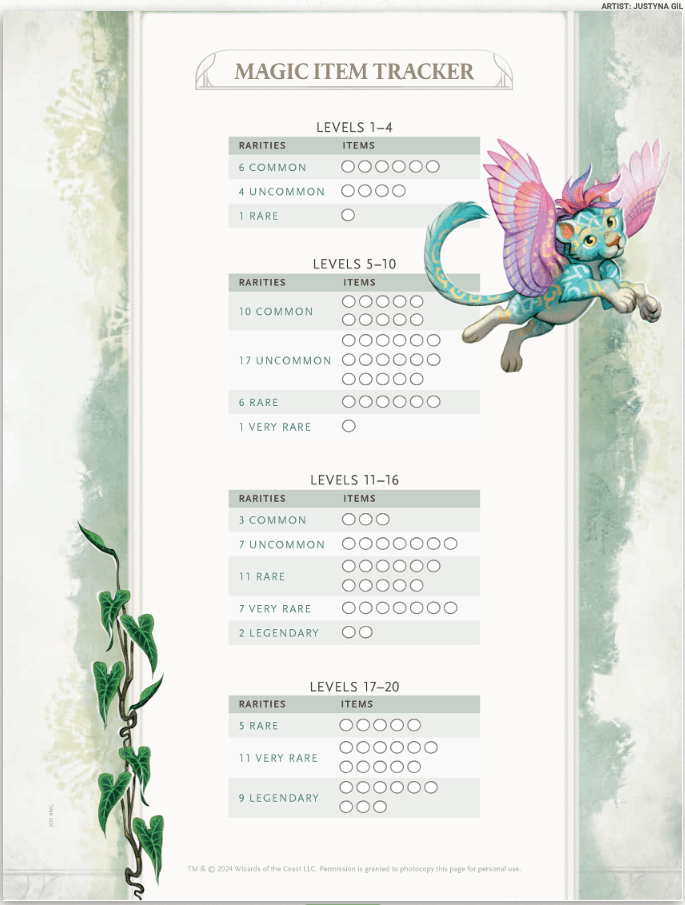
I did take some time to do the math to figure out what this would look like if this was a per-character option. Here’s what the process looked like:
- I assumed the list was designed for a party of four, since that tends to be the assumption in other places in the Dungeon Master’s Guide as well as the Player’s Handbook
- I divided each row of magic items by 4. If the remainder was 1 or 2, I rounded down. If the remainder was 3, I rounded up.
- If a row of magic items had a total of 2 or less, then I took that number and assigned it as a per-party number so that the party wouldn’t miss out on having those magic items.
I also made another change in the per-character list option from the official one in the Dungeon Master’s Guide. The Magic Item Tracker in the DMG states:
… Each time the characters get a magic item, put a check mark in one of the empty circles corresponding to the item’s rarity and the current level range of the characters. If the characters gain a magic item of a rarity that has no unchecked circles at the current level range, check off an empty circle from a lower tier. If all lower level ranges also have no circles left, check off an empty circle from a higher level range.
For me, this made it a little bit cumbersome to do it this way. So the per-character list would be broken down by how many total items each character would have at that tier per rarity level, instead of having to keep track of multiple tiers.
Based on that process and decisions, this is what the per-character magic item tracker would look like.
- TIER 1 (Levels 1-4): 2 Common, 1 Uncommon, 1P* Rare
- TIER 2 (Levels 5-10): 4 Common, 5 Uncommon, 2 Rare, 1P* Very Rare
- TIER 3 (Levels 11-16): 5 Common, 7 Uncommon, 4 Rare, 2 Very Rare, 2P* Legendary
- TIER 4 (Levels 17-20): 5 Common, 7 Uncommon, 6 Rare, 5 Very Rare, 3 Legendary
*#P indicates per party, rather than per character.
What Should Be A Trackable Magic Item?
Another thing that’s missing from this Magic Item Tracker List is what specifically constitutes as a Magic Item that’s worth tracking? In other words, are all magic items of equal weight, or should we make distinctions between permanent magic items and consumables? For example, having a Potion of Healing is definitely helpful and is a magic item but with it being a one time use, I’m not sure I would want to keep track of that. They will use those quite regularly that it ends up being a cumbersome process to do track those. The same can be said of any potion and spell scrolls.
So when you look at consumable/one-time magic items vs. a permanent one such as Ring of Protection, a +1 Weapon or an Enspelled Armor that gains charges back after every long rest, the permanent magic items are going to bear more weight and are easier to track. When you check off a magic item for a character having a magic item, you want to make sure it’s somewhat equitable with what other characters have.

Also… How Do Magic Items Affect Encounters?
The last point I want to make here is less about the tracker list itself but still bears mentioning. We still haven’t received a lot of guidance on how to take into consideration magic items when we build encounters. This is something I’ve seen Dungeon Masters mention time and time again about how you can build an encounter using the rules laid out for it and it gets completely destroyed due to the magic items the party possesses. To be fair, I think this is going to be very difficult to give out blanket advice on this because the type of magic items that players could have can be wide in variety that may not have the same impact on an encounter. But given that we now have a magic item tracker that gives us an idea on how many magic items characters/parties should have, I think there could at least be broad guidance on how to take those things into consideration. It can as simple as “if the characters have half-maximum magic items per the magic item tracker, then assume the players are at the next level up when creating your XP budget for your encounters.”
A Great List That Needs Some Modifications
Overall, the Magic Item Tracker list is a great resource for new and veteran Dungeon Masters alike. This will definitely, at minimum, give us a ballpark idea on where we should be when it comes to magic items. If it could be improved by designing it to be per character and guidance on if all magic items are equal or if there are kinds of magic items that can be left off the tracker, then I think it would be one of the best tools that the Dungeons & Dragons team can offer to Dungeon Masters.
 Crit Hit The Giant