
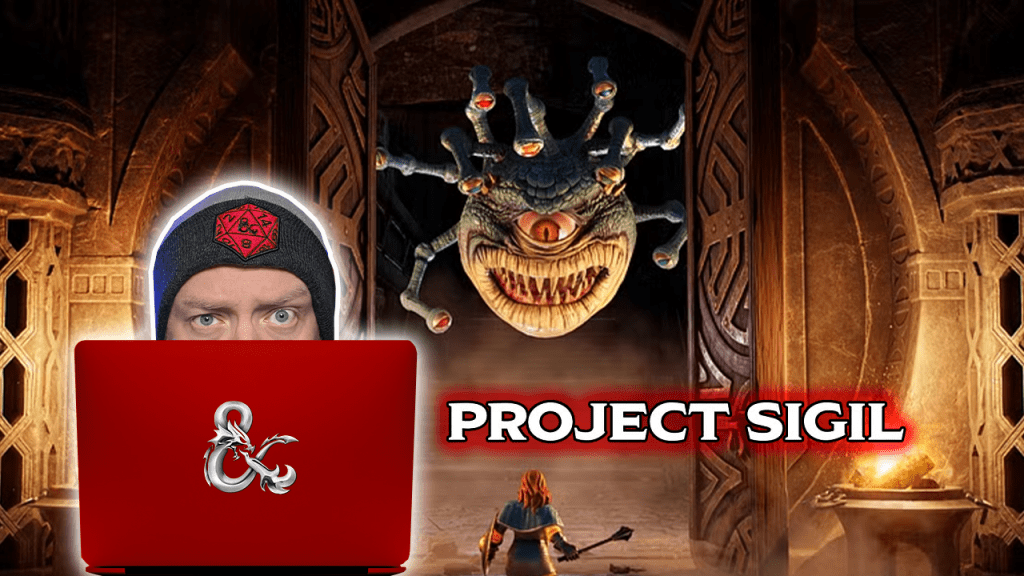
In March of 2023, the Dungeons & Dragons team announced their latest project: a 3D virtual tabletop platform. With the announcement, they released a video demoing the platform being played by the lead project team and well-known players in the community. Earlier this year at their Gen Con press event, the project development team presented an update on the project and announced the name of the platform, Project Sigil. They also had a D&D Live actual play event that included celebrities known in the D&D world (Aabria Iyengar as the Dungeon Master, Anjali Bhimani, Brennan Lee Mulligan, and Samantha Beart & Neil Newbon from Baldur’s Gate 3). During this event, they had the players use the Project Sigil platform, which received mixed reviews from those who attended there for a variety of reasons.
During GenCon, the Dungeons & Dragons team announced that Project Sigil would be available this fall for open beta testing, giving access to those who sign up that have a master tier level subscription on D&D Beyond.
It now seems like beta testing will be postponed until next year as they are not as ready as they were hoping. However, I was invited to check out Project Sigil as a closed alpha tester. This invitation required that I do not share any visual media of the platform, such as screenshots, videos, streams, etc. So this article won’t include any images of the platform itself.
That said, I was able to check out the platform (after spending a week trying to find a way to play it because I didn’t have the right technical requirements). Here are my thoughts on the platform as it current stands, and where I think it should go in the future.
Rather watch a video version of this article? Check out the video version on YouTube below.
For A 3D Virtual Tabletop, This Is Pretty Impressive
I’ll be honest and say that this actually blew me away and went beyond my expectations as a 3D virtual tabletop. The graphics was very detailed, ease of use and navigation was really intuitive, and a lot of opportunities to be able to develop an experience beyond the 2D space are a few things that stood out for me. The standard package came with a tavern and a dungeon already built, but probably the most impressive piece is the options you have for building your own map. With this being in alpha test, it won’t include all of the options they’re planning to integrate. But the fact that you could build a unique dungeon in minutes with features such as randomizing common assets by clicking and dragging across the map is quite impressive.
The combat function is surprisingly easy as well, being able to go right into combat with a click of a button that automates initiative rolls, as well as damage rolls after you attack. Moving automatically tracks how many feet you travel, selecting an action, then picking a target, and you’re already on your way to making combat go quickly. When a player or NPC is hit, the damage is automatically rolled and applied. And every time you select an action that requires a dice roll, you drag or select your dice and digital dice is rolled onto the map itself as though it it part of the table you’re playing at.
It also has the capability to integrate a character you have made in D&D Beyond. This is a great way to be able to help transition people from their D&D Beyond Maps to using Project Sigil in a seamless manner, instead of having to create a character inside the tool itself. Being able to reduce that friction is going to really help sell this product to current customers who use D&D Beyond for their games.
Overall, if you like the idea of creating a video game-like experience or have more visual opportunities, this is an option to check out once it’s released.
Has Come A Long Way, But Still A Long Way To Go
Even though Project Sigil is impressive, there are still a lot of shortcomings with the tool that makes it clear why it’s not ready for beta testing. The map itself doesn’t have easy way to measure length for building. It has the traditional square map plot but when you use the tool to try to build out a floor, you have no idea how far you’re going out unless you stop to count the squares below it. There’s also no apparent way to snap assets together so if I needed to move an entire room somewhere else with the props, I have to do it manually. There’s no undo feature that I could find, and it was very difficult to be able to move the map camera to get to the specific position I wanted to go to on the map.
When a player move their mini from its original position, it’s hard to remember where you started if you need to move back, which can make it problematic during encounters. And although it integrates with D&D Beyond and can pull your character sheet in to create your character, there were many abilities, inventory items, etc. that were missing that I wasn’t able to use (e.g. I had a 3rd level Barbarian and my subclass for Berserker didn’t have Frenzy Attack as an option).
The biggest concern I have right now is the limits on customization. Customization on your character mini; using homebrew classes, items, feats, etc.; flavoring character abilities (e.g. changing a fire bolt to cast a different kind of damage). This really shoehorns you into playing rules as written without any ability to make changes so you resort to having to describe and use your imagination, which one already does with a 2D map or theater of the mind.
So I would be surprise if Project Sigil actually launches by next year because the list of issues that need to be resolve before it hits primetime outweighs what is good about it.
That said, there are some things in the notes of Project Sigil that I am glad to see that does make it optimistic to watch out for. They have a statement in their Quick Start Guide about trying to ensure accessibility for those who rely on assistive technology, which should be a high priority for them. They also listed a lot of features that they are still working on, such as Hardware Performance, Character leveling, Mini maker, Builder mode, and action economy. So although it has a long way to go, it seems like they are aware of it.
Barrier Of Entry Could Be High
The Project Sigil team has a statement about hardware performance, stating that they have a lot of work to do regarding optimization and that they are trying to support things like 2D play to give players options for hardware support.
But this is where the barrier of entry could be high, making the success of this project detrimental.
Right now, the game uses Unreal Engine 5, which is popular for video games as well as film production. Very impressive engine to use to run the game, but it currently requires a Windows computer with some higher than baseline technology requirements (not very high, but a cheap computer won’t do). I was limited because I only had a Mac computer so I tried using my in-laws’ laptop, which didn’t work because the graphics were too weak, and I eventually was able to get a spare computer from my brother-in-law.
The team really needs to prioritize making the tech requirements as little as possible (with high quality) in order to make this work, especially on mobile devices. Not everyone will be able to afford a higher end computer. Many people will rely on a tablet or phone to do things because of its affordability and portability. If Project Sigil launches without an option to use it on mobile devices, they will certainly lose out on a major market of users. If you have just one player who cannot use Project Sigil because they do not have the tech requirements, then the entire party of players will opt out of using it because their players are more important than the platform.
So what about the 2D option? I honestly cannot see this being a good solution for Project Sigil. A 2D option already exists in the form of D&D Beyond Maps as well as other virtual tabletops (VTTS) such as Roll200 and Owlbear Rodeo. The platform itself is not going to be enough to convince players to make their table fit Project Sigil; Project Sigil needs to fit the players’ table.
Here’s my initial reaction on Project Sigil earlier this year before they released it for alpha testing.
Who Is, And Could Be, The Primary Audience
At their Gen Con press event, the Project Sigil team made it clear that their vision is that the platform would be use for play styles of all kind; in person, online, etc. I think they’re being too eager about there being a market for players who plan to play in person. After the cultural and social experience of the pandemic, more people are wanting to interact in person for that social connection, and I don’t see there being a large market for those who are wanting to play their D&D game at the physical table behind their computer or device. Having that type of barrier is what people who are playing in person are trying to avoid to begin with.
But that’s not to say there isn’t a market out there. I think there will be those who play online that will be very interested in this. For younger players who may had their first D&D experience with Baldur’s Gate 3 would be very interested in playing a D&D game that simulates the popular video game. I don’t think it’s going to convert a huge portion of current players, but there will be some, and it will definitely depend on the cost of the platform.
They are also creating this platform to utilize charging for different assets to use in the game (micro transactions), which hasn’t fared well with a lot of people in the community. But that said, someone in a Discord server I belong to mentioned that the new feature in 2024 D&D of building bastions could be a way to bring players in who love to build their own place and show it off online. So whether we like it or not, this sort of experience is a current practice in gaming (Fortnite skins, anyone?) so it’s not a bad idea to offer this option from a business perspective.
I do think one potential market they could tap into are those who play D&D in a form of play-by-post, or PBP.
For those who are not familiar, play-by-post is a popular way to play roleplaying games (RPGs) in a more asynchronous format, such as Discord. You would simply read what other people are doing with their characters when you get a chance, then reply with what your character would do. This format does present its challenges sometime if a player hasn’t kept up with what’s been going on. But I could see Project Sigil creating an active “journal recap” in a sense where a player could read through the posts from other players, and those posts would also reflect/simulate what’s happening in the VTT. So if I read that Derek cast guiding bolt in the journal with some sort of reader function, then when the reading marker gets to that entry, the VTT replays that piece as a way to visually show what had happened while the player was gone. This would call for another layer of technology to create this feature, but I do think that this could be worth the cost to tap into that market of PBPs that has been growing in popularity recently.
Success Will Hinge On Its Pricing Model
At the end of the day, Dungeons & Dragons, Wizards Of The Coast, and Hasbro is a money-making business. So Project Sigil needs to not only sell, but it needs to continue to bring in profits long term in order for it to be sustainable and successful. So undoubtedly this means that there will be a fee associated with using this platform, as well as incorporating some level of micro transactions (the language about pre-ordering the 2024 books include getting a free golden dragon mini to be used for Project Sigil is a strong indicator of this).
That said, many of its customers are already trepidatious about the D&D Beyond marketplace pricing model, with the recent decision to remove a la carte purchases for specific items and forcing users to buy the whole sourcebook instead, as well as rumors about charging to use homebrew items, to name a few. Many people are also on the fence about Project Sigil, and really it’s going to come down to what they’re going to have to pay for using this feature.
There’s a number of ways they could go about it. They can charge an additional fee for each table being used, to charging every item in a marketplace a la carte, or adding it to a subscription service, whether it’s a different tier system or including it in the current one they have for D&D Beyond. They could even add an additional modest fee for when users buy the digital books on D&D Beyond to also purchase the assets that they need to run the adventure or use what’s in the sourcebook for Project Sigil.
However they go about it, what’s clear is that the pricing model will be the tipping point. And many businesses that roll out new platforms first try to get you to use it at a very easy entry point to get you to rely on that service before they start increasing the prices or changing the model as a way to get you hooked in to the service so that it’s more difficult to leave.
So I wouldn’t be surprised if they rolled out something small, such as being able to use a limited amount of assets as someone who has a current master subscription, then being able to purchase additional items piece by piece. Then later on, they change the model where if you want to continue using the items you had through the subscription, you now have to pay an additional fee or use a different subscription service altogether.
I think what may make the most sense that would make this project a business success for the team is to offer a small fee to be able to use a reasonable amount of assets at one time (e.g. 150 items). Not everyone is going to be running multiple games, so to buy items that they may use for one game but not for others wouldn’t make a lot of sense for a user, but to be able to swap out different items for what you need in your games would be more viable for a user. And it has to be a reasonable price as well; something that pushes to $20 a month is probably not going to bring in a large customer base, but DMs who are running games could join this platform for $10 a month. Professional DMs may be willing to purchase it at a larger fee but they are still not as large of a customer base to pursue; so having a tier increase where at $20 users can use 400 items would work for that specific market.
But at the end of the day, the pricing model (cost, access, quality, and quantity) is going to drive the success of this project.
Looking Ahead
Overall, I think Project Sigil has potential to be successful. Because this is such a major investment though, they need to make sure that the product has been stressed-test to its limit to ensure quality and that they receive customer feedback on what makes sense as a pricing model (and not just dictate what it should be without any input from its customer base). If they create this product towards specific markets instead of being hopeful that this will work on all markets and customer types, it will increase its chances of success, which means they need to be realistic about how many people they think will actualy use this at their in-person games (again, not saying people won’t, but I don’t think there will be a large enough market for that).
Personally, I still do not think I will use this in my games, in-person or online. This is very much a video game feel and if I wanted to play D&D the video game, I’d play Baldur’s Gate 3. I also have major concerns about how limiting it is in regards to creativity. Imagination will always win out over any visual aid that we have right now. VTT Maps are there to assist in making the world come to life; it certainly should not be trying to replace imagination. I would much rather have my players and I create the world we’re playing in using our imagination and verbal descriptions rather than feel like we need to use what’s available to us in this platform.
But I’m probably not the targeted market here. This platform will do well for those who would rather have a visual aid to give them a springboard to start from and also include helpful playing tools such as automating attacks, hit point deductions, and so on that can take up some game time. So I think Project Sigil is definitely something to keep an eye out for, but I also do not think that other VTT companies have anything to worry about at this time until D&D can ensure quality at a low level entry with a very affordable price.
![Journey to Gondor and Rohan with New Expansions for The One Ring™and The Lord of the Rings™ Roleplaying 5E [Press Release]](https://crithitthegiant.com/wp-content/uploads/2026/09/ab8c6dad-a0ab-bee7-ba5d-fc6e1cb82e52.jpg?w=1024)

![DUNGEONS & DRAGONS REVEALS NEW ERA FOR FANS WITH WORLD OF WARCRAFT®, DARK SUN, AND STAR WARS EXPERIENCES [Press Release]](https://crithitthegiant.com/wp-content/uploads/2026/07/image-1.png?w=1024)


3 responses to “I was an alpha tester for D&D’s Project Sigil. Here are my thoughts on it.”
[…] I got alpha access to the new D&D 3D Virtual Tabletop (VTT) platform, Project Sigil. […]
LikeLike
I generally agree with your write up but I do think that it will still be very different from a video game. As far as I know it will still use a human DM that can adjudicate and adjust rules. Thank-you for your great article as it gave me hope that this project will not be a flop.
LikeLiked by 1 person
good write up. I’m keen to see what it looks like in the beta.
agree this is likely to have limited use at the table except for those cool in-table/projector setups which we all wish we could do.
LikeLike